Luminiferous terrestrite
Chasing SunlightLuminiferous terrestrite is the defining energy resource of the lightless world and the material basis of human civilization. In its raw state it is a faintly glowing mineral that resists being overgrown or drained of its energy; once processed, it becomes zint, the luminous fuel that powers cities, engines, carriages, industrial machinery, weapons, and the Endeavor. The mineral therefore does more than illuminate the setting: it determines where people can live, how far they can travel, what governments can regulate, and how easily an expedition can be stranded in the dark.
Definition and Material Forms
Luminiferous terrestrite appears in several practically distinct forms. Raw terrestrite occurs in exposed veins, where its dull glow can serve as a landmark in otherwise lightless wilderness. It is difficult to quarry, requiring time, muscle, and zint-powered pick-hammers, but even a limited quantity can replenish an airship’s reserves. The mineral’s resistance to biological growth and energy siphoning makes it unusually persistent in the landscape, while its visible glow makes every deposit both a resource and a point of exposure.
Through distillation, raw material is transformed into zint, also called distilled luminiferous terrestrite. The Endeavor carries a portable distillation apparatus that receives chunks of ore and produces the refined fuel, with lifting gas emerging as a useful but hazardous byproduct. The process is understood by very few, and the machinery required to perform it becomes part of the expedition’s logistical burden. Mining is therefore not simply a matter of finding a vein: the crew must also transport the apparatus, operate it, manage the lifting gas, and protect the resulting fuel.
The world’s terminology reflects this chain of conversion. People commonly call the refined substance zint because of the sound made by the extractors, while raw deposits remain terrestrite veins or raw terrestrite. The same material can thus be encountered as a mineral in the ground, a liquid in storage tanks, a fuel inside engines, and a source of dangerous explosive force. Its changing form links geology to infrastructure and turns a natural deposit into an industrial system.
Urban Infrastructure and Civilian Use
Beacon is built around zint illumination. Its white stone, streets, machinery, and public life are sustained by a network of bright lamps, though older sections still bear the soot of centuries when torches and gas lamps were more common. Zint-powered carriages move through the Port Quarter, replacing animal traction with distilled fuel and making energy consumption visible in ordinary urban transport. The city’s brilliance presents itself as civilization, but its dependence on mined and refined material gives that brilliance a physical cost and a vulnerable supply chain.
The Industrial Quarter reveals the infrastructure beneath this apparent security. There, enormous glass-and-steel stacks extract and distill luminiferous terrestrite, their low, prolonged vibration passing through carriage windows while stray discharges flicker across the structures. The paradox of the district is that its greatest stacks form one of the darkest areas of the city: the machinery that produces light occupies a place where soot, industrial mass, and dangerous energy obscure the illumination it creates. Zint is therefore both the visible sign of order and the hidden laboring system that makes order possible.
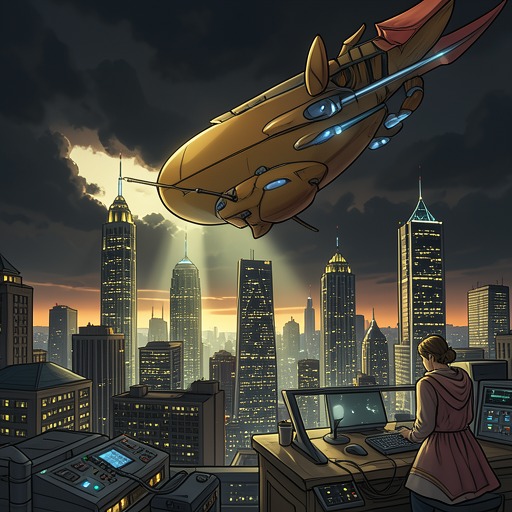
Zint also enables movement beyond the city. The Endeavor’s engines flare blue when pushed to their limits, carrying the expedition eastward above Beacon, while carriages and industrial equipment rely on the same energy regime. Portable searchlights and crew-served zint guns are included among the expedition’s supplies, demonstrating that refined terrestrite supports not only travel and visibility but also armed protection. The fuel is consequently woven into civilian life, military capability, and the expedition’s ability to impose or resist force.
Scarcity, Regulation, and Exchange
Luminiferous terrestrite is valuable enough to function as a currency of access. Jonathan Heights offers Mister Carter four luminiferous gems along with gold plates to improve the Endeavor’s engines, and Carter immediately recognizes that natural gems outperform synthetic versions. The exchange shows that the most effective forms of luminous material are scarce commodities, not interchangeable components. Jonathan’s possession of the gems gives him leverage over a technical decision, while Carter’s response exposes the hierarchy between naturally occurring and manufactured energy sources.
The material is also restricted. Carter hesitates even after testing the gems, explaining that they remain a controlled item; Jonathan answers by displaying the Illuminated King's token. The token does not erase the bureaucracy surrounding the transaction, but it changes what authorization can accomplish. The episode places the mineral within a system of royal regulation in which access depends on official power, administrative permission, and the ability to convert political standing into technical advantage.
That system extends beyond Beacon. At Danby’s Point, human civilization reaches an eastern terminus where illuminated infrastructure meets the territories of other peoples. The human side of the plateau is separated from darker forces by a great zint-lit gate, and trade is tolerated even as the Inquisition attempts to contain contact. Loading the Endeavor there is cheaper and faster than storing every supply in Beacon, so the expedition obtains equipment at the frontier: distillation machinery, lifting-gas separators, siphons and filters, searchlights, weapons, food, water, spare parts, and raw materials. Zint makes this frontier station possible, while the frontier in turn supplies the machines and fuel needed to extend human presence farther east.
The expedition’s maps depend on the same resource logic. Jonathan Heights has charted terrestrite deposits alongside mines, ruined cities, oases, and caravan migrations, because a route without fuel is not a viable route. When the Endeavor loses lifting gas and requires repairs, Captain Montgomery asks for a place to tether and for one of the marked veins. Jonathan selects a southern deposit that can be reached without excessive delay, though he notes that alternative sources would be either too distant or dangerously close to lethal ruins. Navigation is therefore also energy planning: the map is not merely a record of geography but a forecast of where the ship can refuel and survive.
Expeditionary Dependence and Hazard
The Endeavor begins its eastern voyage in terrible condition. Its envelope is mostly burned away, sections of its superstructure are crazed by cracks from a luminiferous detonation, and much of the vessel resembles scrap rather than a ship. Its engines can still be made more effective, but the damaged craft depends on a constant supply of fuel and lifting gas. The expedition’s distance from Beacon turns every reserve into a countdown, and every damaged component increases the importance of the next accessible vein.
This dependence becomes acute when the crew’s intended route reveals an apparently impossible settlement beside a terrestrite deposit. The glow that Jonathan expected to find in rock and brush instead illuminates machinery, walls, mooring towers, streets, and a functioning human town. The discovery is valuable precisely because the Endeavor needs zint and lifting gas, yet it is also suspicious: an unexpected concentration of human infrastructure in the wilderness may be safer than continuing toward distant alternatives, but it may equally conceal a cultist refuge or another threat. The crew chooses to stop because the fuel shortage leaves little real choice, converting energy scarcity into a political and moral risk.
The same resource can attract danger. At Angkor Leng, the Umbraught are identified as beings that consume luminiferous terrestrite, and the powerful spotlight of the Endeavor may have drawn such a creature toward the settlement. The ship’s light is therefore not purely defensive. By broadcasting its energy, it advertises the expedition’s presence to entities whose survival or appetite is tied to the same substance. Zint creates a perimeter of visibility while simultaneously marking a target within the darkness.
The crew must also mine and refine the material under field conditions. Near a river canyon, raw zint glimmers where water has cut through the hills, and the Endeavor is expected to remain tethered for days while the crew gathers supplies and repairs the vessel. The engineer lowers the portable distillery from the cargo deck piece by piece, while other workers prepare the drills and pick-hammers needed to extract the ore. This labor makes the energy system tangible: the expedition’s progress depends on repetitive physical work, hazardous equipment, and the ability to keep the machinery operating far from established support.
Political and Thematic Significance
Luminiferous terrestrite organizes the opposition between human light and the surrounding darkness, but the book refuses to treat light as an immaterial abstraction. Beacon’s illumination is produced by extraction, industrial vibration, restricted goods, transport networks, frontier depots, and the bodies of workers who mine and refine the mineral. The resource makes civilization appear stable while continually reminding the expedition that stability must be supplied, repaired, and defended.
Its political significance lies in the way control over energy becomes control over movement and knowledge. The Illuminated King’s regime regulates the material, the Inquisition facilitates access at the frontier, and Jonathan Heights’s maps identify deposits that determine the expedition’s route. The resource allows human institutions to project power eastward, yet the encounter with nonhuman territories shows that this projection is neither universal nor uncontested. At Danby’s Point, trade crosses the boundary even as authorities try to restrict contact; at Angkor Leng, the same fuel that sustains the ship can summon a predator; in the wilderness, a vein of ore can be a lifeline or a beacon.
The mineral’s most consequential contrast is with sunlight. Zint produces useful brightness in cities and engines, but Beacon’s artificial light feels dishonest to Jonathan Heights, whereas sunlight alone seems to illuminate honestly. The distinction does not make zint useless; without it, the Endeavor could not leave the city, cross the black wilderness, or reach the eastern lands. Instead, it exposes the difference between an energy source that permits civilization to endure within darkness and the sunlight that promises a reality beyond that civilization’s enclosed system. Luminiferous terrestrite is the indispensable substitute that makes the search for sunlight possible, and the material reminder that every attempt to reach the truth begins inside an infrastructure of dependence.